Sir Jasper of Highland House
Circa 2005 - 21 January 2025
Dogs' lives are too short. Their only fault, really. Agnes Sligh Turnbull

Sir Jasper of Highland House
Circa 2005 - 21 January 2025
Dogs' lives are too short. Their only fault, really. Agnes Sligh Turnbull
 |
| Pumpkins and pole beans "share" space |
 |
| The Vegetable boxes in mid-July |
Likewise, my vegetable boxes are champing at the bit. The indigo, my impulse buy in early June, is really getting pushy. . .I may need to harvest and dye something sooner rather than later. . .but the basil, eggplant, tomatoes (so tall!), kale (!) and potatoes are all flourishing. I'm afraid to say this lest I jinx it.
 |
| Clematis |
It is a time when the ornamentals are at their summer peak. I won't bore you with all of them, but by mid-August, most will look pretty tired and spent. Some will be setting next year's flower buds, some will be recovering from all of that reproduction, some will just be hot and tired.
But for now, they shine. All of them.
 |
| Yet another day lily |
 |
| Hydrangea |
 |
| The tall ones in a favorite vase |
Also of note, I harvested a few blueberries yesterday. . .plump and fully blue, so delicious, and a bunch of raspberries. These pictured are from last Tuesday, but Thursday's crop was considerably bigger. Raspberries for breakfast, lunch, and dinner until we get sick of them, and then I'll start on the jam. Smile. Raspberries for the winter.
 |
| Small beginnings |
These are summer raspberries. . .a cultivar called 'Killarney'. We never grew it elsewhere, because it's big claim to fame is it's cold hardiness. But moving to Maine, it seemed a good idea. I was unimpressed with its size, flavor, color and thorniness for the first couple of years, but I'm pretty impressed with size and flavor this year. It's not as red at full ripeness as my fall fruiter (JoanJ), not as large either. But it's a decent eating berry. Last year I was sprinkling it with a little sugar to eat straight, but this year I'm not. It's pretty delicious as is. I did see my first Japanese Beetle on a leaf yesterday. I'll have to monitor that closely. I hate to spray unnecessarily, but those critters can ruin the whole business. Japanese beetles so love all of the family Rosaceae. That includes not only raspberries, but my apples, plums and peach. Can't have that.
Other horticultural items, the basil is ready for the first big cutting (pesto!), all of the herbs are doing exceptionally well, even the little cilantro that I transplanted from a grocery store pot, and the bean and pumpkin vines have decided to overtake the entire yard. Food is so great!
 |
| Cornus canadensis |
I just thought I'd share this new discovery. It's a plant we discovered while hiking on Plummer's Point Preserve over the weekend. Clearly a dogwood, id'd as Cornus canadensis. The common names are Bunchberry or Creeping dogwood. It's a native (with a very large range), and while we missed the flowers, the groundcover alone is lovely enough to have me very interested.
Wikipedia provided the image of it flowering. I'm thinking a lot about where this will thrive in our garden/woods.
| Cornus canadensis flowering. THX, Wikipedia! |

I decided to document where the garden is a couple of days ago. It's a longish video (11 minutes or so. Funny that that seems long now. . .), so don't feel obligated to watch. It was fun to make. Oh. And be sure to turn on the sound. . .it makes a lot more sense with it.
The State of Highland House Garden

In the case of Folly, a lot Did go right. I was able to make the pieces fit nicely. The form came together mostly as envisioned, and the embellishments proved joyful work. The various sides are continued like a 4-sided canvas. It's true that the embellishments are more cliche. . .perhaps formulaic. . .than I would prefer, but all in all, I can overlook that. AND! I dried her slowly slowly, and through the drying, and both firings, there were no rebellious cracks.
The most terrible disappointment was the glaze. While it looks like it's only a flat white, I actually had lightly "kissed" the white with a dark green glaze. The green continued around the piece in a spiral. What green? For some reason it didn't show up at all in the finished piece. It's as though the Klaus Hard White swallowed the Coyote Matt Green. A disturbing thought. I had to cover over some dark green underglaze I had used on the hidden parts of the assembled piece because they showed up as horizontal lines dividing the vertical form. I did not like that one bit. Then, as I was doing that bit of magic, I dropped the lid and broke it. It was not a terrible break. . .I was able to glue it together admirably well. But I know it happened.
One of the things I loved about the concept of the piece is that it fits together as separate, discreet sections that can be used as a place for secret treasures, or as 3 separate vases.

For the sake of being complete, I'll include images of the other three sides.They're not bad. I may make a series. I love the idea of making them in porcelain, round, with No Glaze. Take that, Glaze.

There is some precedent for the idea of doing more Follies. Folly Camelot, Folly Royale. . .name your Folly. I made a large enameled torque back when I was enameling that was called 'Primal'. I loved making it, and it was actually sold before I displayed it, so it was satisfying on several levels. The last in the dozen or so I made was 'Primal domestica'. I traded that piece for an original painting by Jerry Lisk of Boise fame.
And isn't our current world so full of very upsetting Follies, that maybe some more whimsical Follies is just what we need. I'll have to think on it. Right now I'm exhausted with her.


Things have been crazy busy on all fronts. . .trails, garden, office, friends, and the studio. I had the idea for this piece (about 24" tall, which is large for me) several weeks ago when I decided that I needed a tall slender piece for a specific place in our bedroom. It was influenced by a very cool set of tins that I had gotten from The Bees Knees in Boston, which were stacking tins.
So. This is called Folly. See it on all sides in This Video. It is three separate vessels that stack together. This is, of course, the raw clay form. I am very unsure as to whether it will survive drying and two firings (the last being a glaze firing), so I thought I'd show it to you now. It may not live long, but it deserves a little airtime.
The British wealthy used to build Folly's on their extensive property holdings. They were buildings, often large and ornate, that sort of looked useful, but actually weren't. There were eccentric indulgences. This piece isn't exactly that, since it will be somewhat useful, but it feels like it has some of that spirit. It is, rather, functional and decorative. Those are kisses of death in academic art circles, but I'm ok with that. It was a challenge to make, and it may even make it. If it does, Folly will make another appearance.


The forest floor was covered in some areas with buttercups, and there are other areas that are swathed in Jewel Weed. Some folks don't like that one, but they aren't very competitive in the garden, and I love that they bloom late in summer, when color is harder to come by. Their orange-spotted yellow leguminous flowers also develop those very fun seedpods that explode when you touch them. Evolution has so many interesting twists and turns.
 |
| Buttercups |
 |
| Jewel Weed leaves |
 |
| Viburnum |
 |
| More viburnum |
Of course, there is some truly bad news. While I'm somewhat circumspect regarding some invasive species, the Japanese Knotweed is just killing us. Killing all around it. It has taken over areas in the forest, and closes in on trails. In another two weeks the trails below won't be passable. Our area there is small enough that we can come in a whack it back with a bush hog, but it will be a constant job. And I know that in the end, the plant will beat us. It's like kudzu in the south. There is simply no defeating it.
 |
| Japanese Knotweed |
 |
| Blackberries getting ready to sing |
So. How about I end on a positive note? This last image is of blackberry buds. They are getting ready to burst into bloom, and offer up their wild progeny. Blackberries are such vigorous plants that many an agronomist sees them as a weed, rather than a crop. It makes me wonder how they'll hold up against the Knotweed.
 |
| The potatoes emerge |
 |
| Oak seedlings |
We had an enormous number of acorns last year. Walking across the lawn felt like you were walking on large ball bearings. They were actually dangerous. So now, the oak seedlings are everywhere, often in bunches. I'll be pulling these and the Ash tree seedlings out of all of my beds for the foreseeable future.
 |
| Double-File Viburnum flowers |
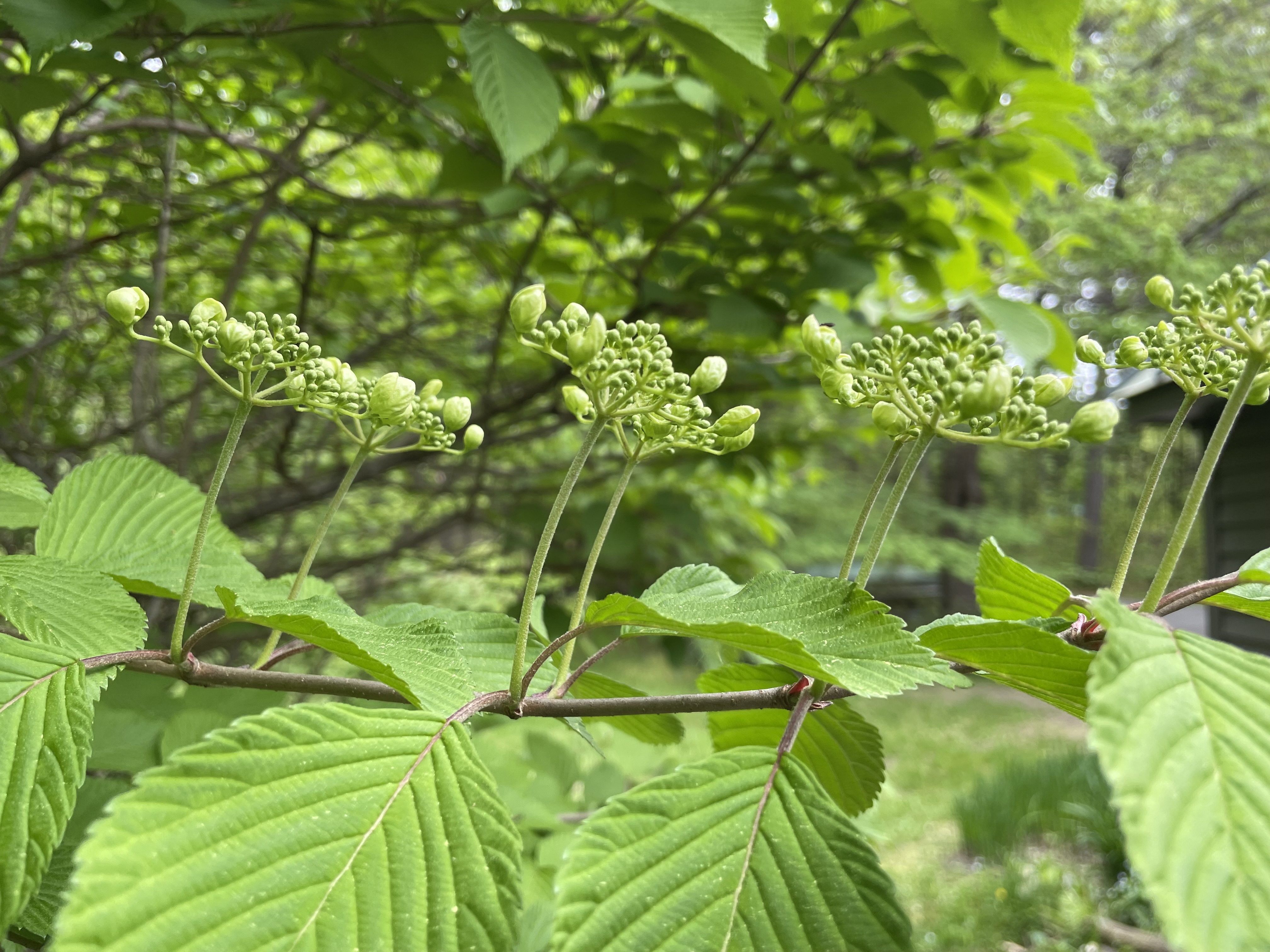
In hindsight, it seems odd that someone like me, who has 3 degrees in Horticulture, was unfamiliar with this plant. I'll need to find out how recently they were released. With all of the plant I.D. classes I had, you'd think. . . after all, that was where I first developed my love of Metasequoia glyptostroboides. And yes, spellcheck, that is the proper spelling.
 |
| Double-File Viburnums |
The leaves are the trifoliate ones in the image. You can see that one has had a bite taken out of it.
 |
| Jack-in-the-Pulpit, day 5 |
 |
| Jack-in-the-Pulpit leaves |

I'll start with the beauty, since the beast is such a Fresh Hell. Hats off to Dorothy Parker for immortalizing that phrase. It has never, in my life, been more spot on.
John took the picture of these Jack-in-the-pulpits. Pretty amazing, isn't it? They are really tough to spot on the forest floor. They are also, according to the internet, extremely poisonous. Sort of a variation of "pretty with teeth". I'm going to wander down to this spot everyday to see how they progress. I may even remember to bring my phone, so stay tuned.

The Fresh Hell Beast is this disease that is showing up all over our region. It's called Beech Leaf Disease, and as far as we can see, it's infecting almost all of our Beech trees. This is devastating, under any circumstance, more so given how much of our forest is beech. The Maine Forestry Service says it is "associated" with a non-native nematode. (see Beech Leaf Disease)
The disease first showed up in Ohio in 2012, but by 2020 has reached all the way up Maine, and across to Michigan. The spread seems to be much more eastward than westward.
 Small trees on our property are already dead from it, and we can see it in the over story, though not the highest over story. I have a dread that I can hardly write that it will infect our beautiful Copper Beech, which, as I said in an earlier post, had an unusual leafing out pattern this year. We don't see the distorted leaves yet.
John once commented that it must have been a horrific sight when all of the American Chestnut forests died. Miles and miles of dead mature forest. My chest gets tight, my eyes tear.
What webs we weave.
 |
| Lady Slipper |
It was nothing but good news. The black flies and mosquitos did not make an appearance, and the Lady Slippers and Trillium are REALLY showing off right now. Their bloom is not long lived, so it's a real treat when one gets to experience it. I Was glad that I had a coat on. It was initially chilly, but we warmed as we hiked. It's not an easy hike.

I couldn't have been more thankful for the reminder that even in cool springs, central Maine is worth the trouble. I didn't see another soul on this hike. The trails is rooty and rocky, but then, that's the forest in Maine. Lots of rocks. A ton of trees.


 This is a favorite fall and winter hike, but I'm really glad Jasper and I made the trip. So much hidden treasure.
 |
| Bleeding hearts |
For some reason the volume of the bleeding hears surprise me every year. They are in deep shade in the summer, but this time of year, before the Copper Beech above them leafs out, they are a marvel. Generous and beautiful. The daffodils and tulips are done, by the way, as are the Scylla and the snow drops.
 |
| Blueberry blossoms |
 |
| A budding columbine |

 |
| Weeping Crabapple |
 |
| Geraniums |
 |
| Siberian Bugloss |
The geraniums (also called Cranesbill) are just tuning up. They are also threatening a spectacular bloom this year.
Siberian Bugloss, or Brunera, is in full throat right now. It's a delicate voice, but utterly beguiling. And long after the flowers fade, the leaves enchant.
 |
| Peach blossoms past petal fall |

 |
| Apple blossom |
The above is a crabapple. She also had incredibly abundant blossoms this year. To the right is a later blooming apple tree. I'm not holding out a lot of hope for a crop, but it could happen. These plants have, after all, evolved to produce seeds, and the fruit is bound up in that. We'll see.
 |
| Lilac flowers |
And then there are the lilacs. I cut some large very old branches out of this one during winter pruning. I'm hoping that plant physiology will work, and that the pruning will inspire the plant to throw up new young shoots.
 |
| Candles on a dwarf blue spruce |
Other things are happening too. The evergreens are all showing off their candles (the hemlocks are particularly charming), the asparagus are starting to fill in after we have cut them for (perhaps) too long, and the rhubarb.
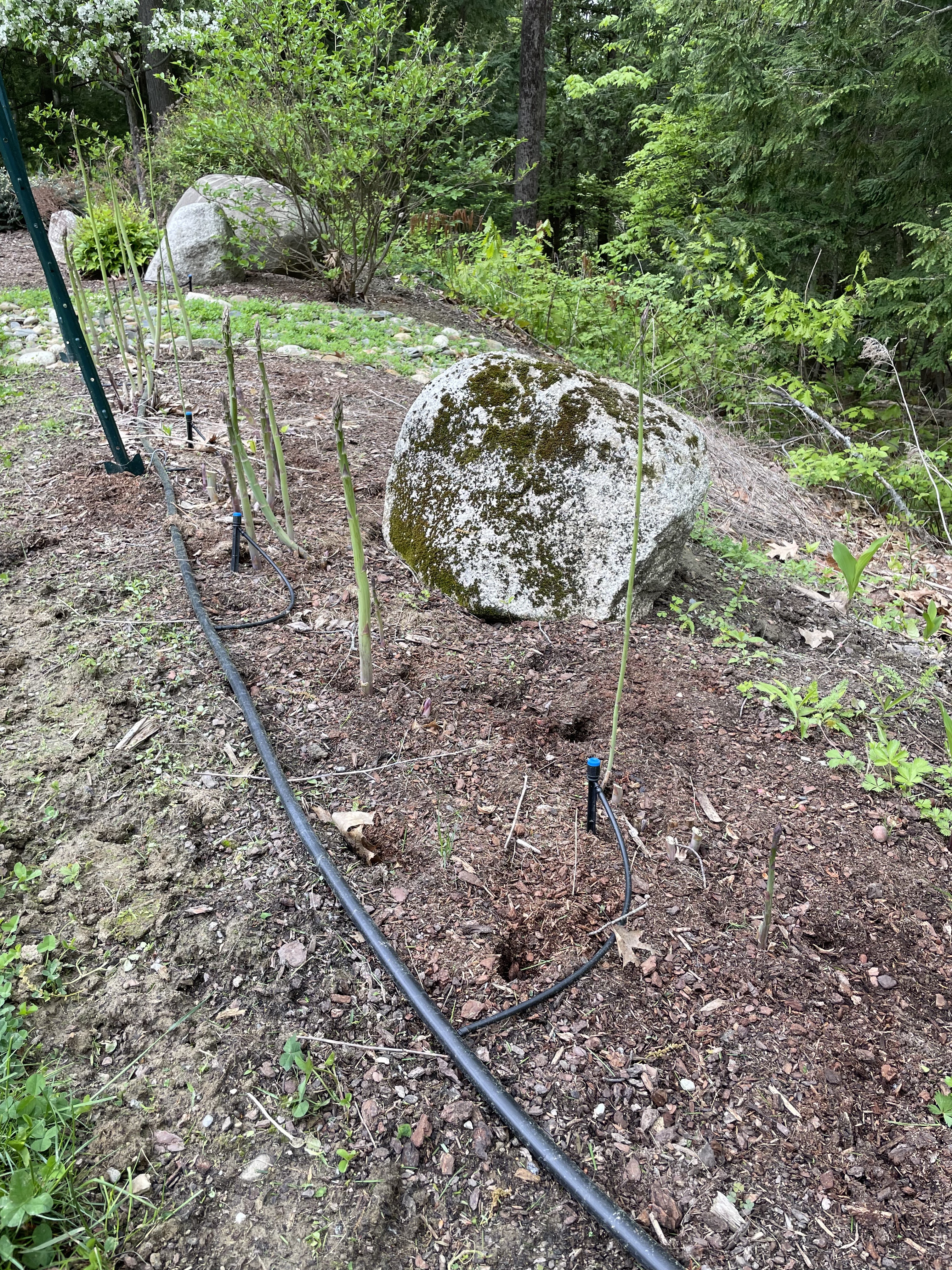 |
| Asparagus |
 |
| Rhubarb! |
 |
| Phlox |
 |
| Double file viburnum |
 |
| Beleaguered Rhododendrons |


